



Drying may look like one of the simplest steps in car washing. The towel used during this stage can make a noticeable difference to the final result. A good car drying towel should remove water quickly. It feels soft against the paint and reduces unnecessary friction on the vehicle surface.
For professional detailers, car care brands and distributors, these three factors — absorbency, softness and scratch protection — are the key points to consider when choosing a microfiber drying towel.
What actually determines the performance of a car drying towel?

Absorbency Is More Than Just GSM
GSM, or grams per square meter, is commonly used when comparing microfiber towels. A higher GSM usually means that there is more fabric per square meter. It can contribute to greater water-holding capacity.
GSM alone does not tell the whole story.
Two drying towels with similar GSM can perform very differently. Their fiber structure, knitting method and overall construction create this gap.
Twisted-loop microfiber towels use long twisted fibers. These fibers create a large contact area for collecting water. This structure makes them particularly suitable for drying larger vehicle panels such as roofs, doors and bonnets.
Plush microfiber towels use a softer, more traditional pile. They can also absorb a significant amount of water. They provide a different hand feel.
For buyers, the important question is therefore not simply:
“What is the highest GSM available?”
A better question is:
“Which fabric construction provides the right absorbency for the intended drying application?”
An extremely heavy towel is not always necessary. The ideal product should absorb enough water. It remains easy to handle, fold and wring out when required.
Why Softness Matters on Car Paint
Automotive paint, especially clear-coated and high-gloss finishes, requires careful handling.
The towel moves directly across the freshly washed surface during drying. A rough fabric, hard edge or contaminated towel can increase friction. It can potentially contribute to fine marks on the finish.
Softness is one of the most important characteristics of a microfiber car drying towel. Good microfiber uses very fine synthetic fibers. These fibers create a soft contact surface.
The pile provides some cushioning between the user’s hand and the vehicle surface. It helps the towel move more smoothly across the paint.
Softness is influenced by several factors.
They include:
- Fiber quality
- Polyester and polyamide composition
- Pile structure
- Fabric density
- Finishing process
- Edge construction
A towel that feels thick is not automatically soft. A towel that feels soft when new still needs to maintain that feel after repeated washing.
For professional car care products, consistency after use is just as important as the initial hand feel.
Can a Microfiber Towel Really Prevent Scratches?
The phrase “scratch-free” is frequently used for automotive microfiber products.
Scratch protection depends on both the towel and the way it is used in practice. No drying towel can protect a vehicle. Sand or hard dirt particles remain on the paint.
A quality microfiber drying towel helps reduce the risk of surface marks. Its soft fibers provide a gentler contact surface. Its pile can hold small particles away from direct contact with the paint.
Proper washing before drying is still essential.
Detailers should remove loose dirt thoroughly. They do this before the towel touches the vehicle.
Clean towels should also be kept separate from towels used on wheels, tires and other heavily contaminated areas.
Drying technique matters as well.
Users can gently glide the towel over the surface. They can also place it on the panel and let the microfiber absorb the remaining water. They avoid applying heavy pressure.
The goal is not to scrub the vehicle dry. It is to let the towel do the work.
Twisted-Loop vs. Plush Microfiber Drying Towels
Different microfiber structures create different drying experiences.
Twisted-Loop Drying Towels
Twisted-loop microfiber has become increasingly popular for automotive drying.
The long twisted fibers quickly collect water from large surfaces. They provide strong drying efficiency. This makes the construction especially suitable for full-car drying towels.
Typical advantages include:
- High water absorption
- Fast drying of large body panels
- Good coverage
- Reduced need for repeated wiping
- Suitable for professional detailing and car wash use
Twisted-loop drying towels are often an important product category for buyers developing a premium car care range.
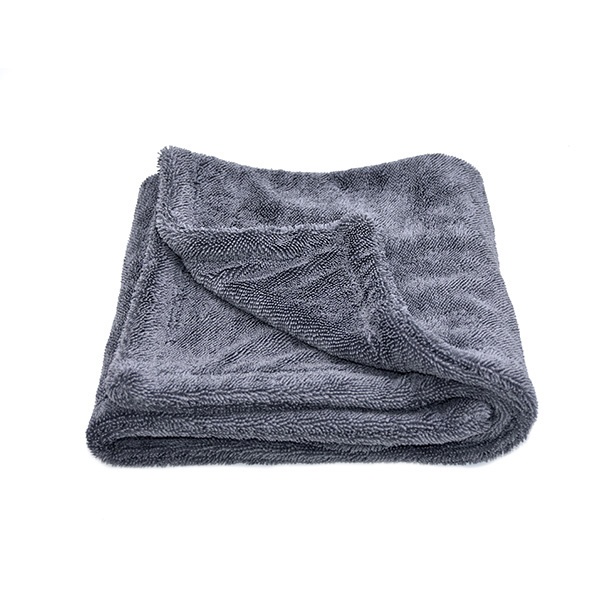
Plush Microfiber Drying Towels
Plush microfiber has a softer, fluffier surface.
It can be used for drying as well as detailing and finishing work. Its density and construction decide its functions. Its soft hand feel makes it attractive for consumers. These consumers place particular emphasis on paint care.
Plush towels can also be a practical option for smaller drying towels or multi-purpose car care kits.
Neither structure is automatically better in every situation.
Product selection should depend on target customers, towel size, GSM, price positioning and intended use.
Edge Design Should Not Be Ignored
The fabric is not the only part of the towel that touches the vehicle. Edges can also come into contact with the paint during drying.
Buyers often prefer soft edge treatments or edgeless constructions for premium automotive applications. These designs minimize hard contact points.
Common options include soft fabric edging, laser-cut edges and edgeless designs. Conventional stitched edges may still be suitable for economy products.
People should check the edge material and workmanship carefully.
People may look only at the center fabric and ignore the edge construction when evaluating a car drying towel.
This habit can result in an incomplete quality assessment.
Size Also Affects Drying Performance
A larger towel can cover more of the vehicle and hold more water.
Bigger is not always better. An oversized towel may become heavy once saturated. It can be more difficult to control around mirrors, bumpers and smaller panels.
Smaller towels are easier to handle.
They may require more frequent wringing or multiple towels to dry a complete vehicle.
Offering more than one size can therefore make sense for retail car care ranges.
Large drying towels are suitable for full-car exterior drying.
Smaller versions can be positioned for windows, door jambs, motorcycles or final touch-up work.

What Should B2B Buyers Check Before Ordering?
Car care brands, wholesalers and distributors choose a drying towel.
The work involves more than comparing price lists.
It is useful to evaluate these items before confirming a product:
- Fabric construction
- GSM and actual towel weight
- Towel size
- Water absorption
- Surface softness Lint performance
- Edge finishing Durability after washing
- Color consistency
- Packaging options
Samples should ideally be tested in a real car washing environment.
A towel may look impressive in a specification sheet.
Practical testing shows how quickly it absorbs water, how it feels when wet and whether it remains easy to handle during use.
Finding the Right Balance
The best car drying towel is not necessarily the thickest or the heaviest.
A well-designed towel achieves a balance between water absorption, softness, drying speed and ease of use.
Buyers may prefer high-density twisted-loop towels with soft edge treatments for premium detailing products.
A lighter but well-constructed microfiber towel may offer a better balance between performance and cost for mainstream retail ranges.
Different markets and price levels require different solutions.
Fabric structure should always be selected according to the final application.
People should not rely on one specification alone.
Final Thoughts
A car drying towel has a simple job.
It removes water from the vehicle.
Doing that job well requires careful material selection. Absorbency helps reduce repeated wiping. Soft microfiber provides gentle contact with the paint.
Proper fabric and edge construction help reduce unnecessary friction during drying.
A microfiber drying towel can make vehicle drying faster, easier and safer for the paint surface when these elements are balanced correctly.
Understanding these differences also makes it easier to select the right products for different customers and price levels.
This helps car care brands and distributors develop their own microfiber towel range.
PHOEBETAI provides customized microfiber car drying towels in different fabric structures, GSM, sizes, colors and packaging options.
From twisted-loop drying towels to soft plush microfiber constructions, products can be developed according to different retail, detailing and private-label requirements.


